Python Programming
Reference documents in Python Programming.
Documents in Python Programming
Page 4 of 7-
Even though JavaScript tools dominate today’s web development landscape, Python provides aspiring web developers with a wide variety of useful web frameworks, written in a powerful, easy-to-learn language. This O’Reilly report surveys 30 Python web frameworks that have more than 1,000 monthly downloads and provides a deeper look into six of the most widely used.
-
This book written to provide clear and concise explanation of topics for programmers both starting to learn the Python programming language as well as those diving in more complex topics. Most examples are linked to online playground that allows you to change the code and re-run it.
-
Python is a widely used general-purpose, high-level programming language. Its design philosophy emphasizes code readability, and its syntax allows programmers to express concepts in fewer lines of code than would be possible in languages such as C. The language provides constructs intended to enable clear programs on both a small and large scale.
-
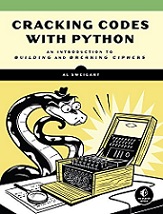
This book uses Python and some standard cryptographic libraries in Python to explore these cryptological ideas. It should be accessible to students with a solid basic comfort level with Python – but could also be used as a way to solidify Python knowledge in more beginning users of that language, particularly if those beginners had a friendly instructor or peers with whom to collaborate.
-
Learn how to program in Python while making and breaking ciphers—algorithms used to create and send secret messages!
-
The Hitchhiker's Guide to Python takes the journeyman Pythonista to true expertise. More than any other language, Python was created with the philosophy of simplicity and parsimony. Now 25 years old, Python has become the primary or secondary language (after SQL) for many business users. With popularity comes diversity - and possibly dilution.
-
This book is a tutorial for the Python 3 programming language designed for someone with no programming experience. Starting from no programming knowledge, the book teaches how to create programs with examples, explanations and exercises.
-
This open access guide shows you how to apply Test-Driven Development (TDD) to building real-world web applications with Python. You'll learn how TDD leads to clean, reliable, and maintainable software.
-
This book is a hands-on introduction to the Python programming language, written for people who have no experience with programming whatsoever. After all, everybody has to start somewhere.
-
A Whirlwind Tour of Python is a fast-paced introduction to essential features of the Python language, aimed at researchers and developers who are already familiar with programming in another language. The material is particularly designed for those who wish to use Python for data science and/or scientific programming, and in this capacity serves as an introduction to my longer book, The Python Data Science Handbook.
-
This book contains many ready-to-use, focused recipes for high-performance scientific computing and data analysis, from the latest IPython/Jupyter features to the most advanced tricks, to help you write better and faster code. You will apply these state-of-the-art methods to various real-world examples, illustrating topics in applied mathematics, scientific modeling, and machine learning.
-
Professional developers know the many benefits of writing application code that's clean, well-organized, and easy to maintain. By learning and following established patterns and best practices, you can take your code and your career to a new level.
-
Learning Python has a dynamic and varied nature. It reads easily and lays a good foundation for those who are interested in digging deeper. It has a practical and example-oriented approach through which both the introductory and the advanced topics are explained. Starting with the fundamentals of programming and Python, it ends by exploring very different topics, like GUIs, web apps and data science. The book takes you all the way to creating a fully fledged application.
-
This book introduces the basics of Python programming and geographic data analysis for all “geo-minded” people (geographers, geologists and others using spatial data). You'll learn how to apply Python GIS geospatial processes to a variety of problems, and work with remote sensing data.
-
This book covers Python from the very basics. Suitable for GIS practitioners with no programming background or python knowledge. The course will introduce participants to basic programming concepts, libraries for spatial analysis, geospatial APIs and techniques for building spatial data processing pipelines.