Python Programming
Reference documents in Python Programming.
Documents in Python Programming
Page 3 of 7-
This book provides a reader with a holistic and in-depth knowledge of the Python language. It explains how methods and functions are related, how sequences can be created elegantly, the tools for functional programming, how user defined objects can be no different from Python objects and how one can control almost everything from import statements to class creation using meta-classes and decorators etc.
-
This book is a guide to learn Python programming. Precise code examples and broken down explanations, neatly organised into chapters. Provides links to external resources for supplementary reading wherever required. It provides a solid foundation for learning to code.
-
This document is a syllabus for a second course in Python programming. This course contains discussions of several advanced topics that are of interest to Python programmers: regular expressions, unit tests, extending and embedding Python, parsing, GUI applications, guidance on packages and modules.
-
Python is a powerful high-level programming language that is popular across the world. It is used extensively by large corporations and individual developers alike. One of the biggest selling points of Python is the simplicity of its programs compared to other languages. It is remarkably easy, for even complete beginners, to create fully functional programs in minutes.
-
Porting to Python 3 doesn't have to be daunting. This book guides you through the process of porting your Python 2 code to Python 3, from choosing a porting strategy to solving your distribution issues.
-
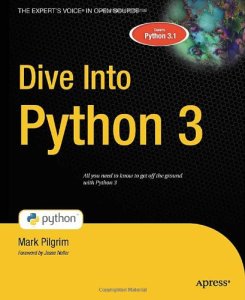
If you've never programmed before, Python 3 is an excellent language to learn modern programming techniques. But this book should not be your starting point. Get "How to Think Like a Computer Scientist: Learning with Python" by Allen Downey, Jeffrey Elkner, Chris Meyers and learn the basics. Then dive into this book. Dive Into PYTHON 3 was written by Mark Pilgram, and this edition is distributed under the terms of the Creative Commons Attribution Share-Alike License 3.0. * Money raised from the sale of this book supports the development of free software and documentation. About the Author: By day, Mark Pilgrim is a developer advocate for open source and open standards. By night, he is a husband and father who lives in North Carolina with his wife, his two sons, and his big slobbery dog. He spends his copious free time sunbathing, skydiving, and making up autobiographical information.
-
This report guides you through the implicit decision tree of choosing what Python version, implementation, and distribution is best suited for you.
-
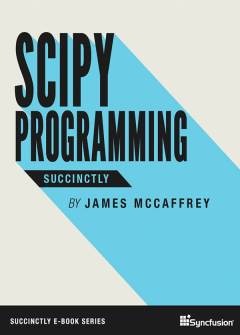
This book offers readers a quick, thorough grounding in knowledge of the Python open source extension SciPy. The SciPy library, accompanied by its interdependent NumPy, offers Python programmers advanced functions that work with arrays and matrices.
-
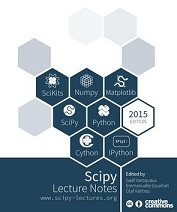
This book consists of a set of is tutorials on the scientific Python ecosystem: a quick introduction to central tools and techniques. The different chapters each correspond to a 1 to 2 hours course with increasing level of expertise, from beginner to expert.
-
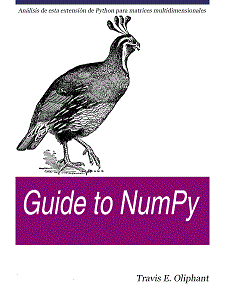
NumPy is an extension of Python, which provides highly optimized arrays and numerical operations. NumPy replaces a lot of the functionality of Matlab and Mathematica specifically vectorized operations, but in contrast to those products is free and open source. In today's world of science and technology, it is all about speed and flexibility.
-
NumPy is one of the most important scientific computing libraries available for Python. This book teaches you how to achieve expert level competency to perform complex operations, with in-depth coverage of advanced concepts.
-
This book presents computer programming as a key method for solving mathematical problems. There are two versions of the book, one for MATLAB and one for Python. The book was inspired by the Springer book TCSE 6: A Primer on Scientific Programming with Python (by Langtangen), but the style is more accessible and concise, in keeping with the needs of engineering students.
-
This book aims to enable the reader to quickly acquire a Python foundation. The material particularly feel quite comfortable to anyone with background in an object-oriented programming (OOP) language such as C++ or Java.
-
Even the best programmers make mistakes, and experienced programmer Mike Pirnat has made his share during 15+ years with Python. Some have been simple and silly; others were embarrassing and downright costly. In this O’Reilly report, he dissects some of his most memorable blunders, peeling them back layer-by-layer to reveal just what went wrong.
-
This book goes beyond the basics to teach beginner- and intermediate-level Python programmers the little-known tools and constructs that build concise, maintainable code. Design better architecture and write easy-to-understand code using highly adoptable techniques that result in more robust and efficient applications.