Machine Learning
Reference documents in Machine Learning.
Documents in Machine Learning
Page 1 of 4-
Machine learning is one of the fastest growing areas of computer science, with far-reaching applications.
-
Machine learning techniques have the potential of alleviating the complexity of knowledge acquisition.
-
Even since computers were invented, many researchers have been trying to understand how human beings learn and many interesting paradigms and approaches towards emulating human learning abilities have been proposed. The ability of learning is one of the central features of human intelligence, which makes it an important ingredient in both traditional Artificial Intelligence (AI) and emerging Cognitive Science.
-
The goal of this book is to present the latest applications of machine learning, which mainly include: speech recognition, traffic and fault classification, surface quality prediction in laser machining, network security and bioinformatics, enterprise credit risk evaluation, and so on.
-
The purpose of this book is to provide an up-to-date and systematical introduction to the principles and algorithms of machine learning. The definition of learning is broad enough to include most tasks that we commonly call "learning" tasks, as we use the word in daily life. It is also broad enough to encompass computers that improve from experience in quite straightforward ways.
-
Machine learning is no longer just a tool for data scientists. By taking advantage of recent advances in this technology, UI and UX designers can find ways to better engage with and understand their users. This O'Reilly report not only introduces you to contemporary machine learning systems, but also provides a conceptual framework to help you integrate machine-learning capabilities into your user-facing designs.
-
In this book, it will be exploring machine learning, the concepts that run these technologies and by the time you get to the end you will have more knowledge than many and will be equipped to start building your own applications.
-
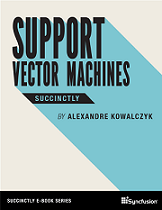
In machine learning, support vector machines (SVMs, also support vector networks) are supervised learning models with associated learning algorithms that analyze data used for classification and regression analysis.
-
This book will be your practical guide to working with cognitive APIs developed by Microsoft and provided with the Azure platform to developers and businesses.
-
This book describes an open machine learning architecture. Including key aspects that are involved for real business use. It focuses on Free and Open Source Software (FOSS) machine learning software and open datasets.
-
This book is a comprehensive textbook on the subject, covering a broad array of topics not usually included in introductory machine learning texts. In order to present a unified treatment of machine learning problems and solutions, it discusses many methods from different fields, including statistics, pattern recognition, neural networks, artificial intelligence, signal processing, control, and data mining.
-
Efficient Learning Machines: Theories, Concepts, and Applications for Engineers and System DesignersMachine learning techniques provide cost-effective alternatives to traditional methods for extracting underlying relationships between information and data and for predicting future events by processing existing information to train models. This book explores the major topics of machine learning, including knowledge discovery, classifications, genetic algorithms, neural networking, kernel methods, and biologically-inspired techniques.
-
This Open Access proceedings presents new approaches to Machine Learning for Cyber Physical Systems (CPS), experiences and visions.
-
Today's Web-enabled deluge of electronic data calls for automated methods of data analysis. Machine learning provides these, developing methods that can automatically detect patterns in data and then use the uncovered patterns to predict future data.
-
This book blends the foundational theories of machine learning with the practical realities of building tools for everyday data analysis. You'll use the flexible programming languages to build programs that implement algorithms for data classification, forecasting, recommendations, and higher-level features like summarization and simplification.