Theory of Programming Languages
Reference documents in Theory of Programming Languages.
Documents in Theory of Programming Languages
Page 1 of 1-
The Dictionary of Programming Languages is an online compendium of computer coding methods assembled to provide information and aid your appreciation for computer science history. The dictionary currently has over 120 entries.
-
This book is an introduction to the mathematical theory of programming languages. It is in tended to provide a first course, one that is suitable for all university students of Computer Science to take early in their education.
-
The goal of this book, is to expose first-year graduate students to a wide range of programming language paradigms and issues, so that they can understand the literature on programming languages and even conduct research in this field. It should improve the students' appreciation of the art of designing programming languages and, to a limited degree, their skill in programming.
-
This book tries to explain a number of programming languages, covering a wide range from currently popular ones such as Java, Perl, Python, and C# to less known languages such as ML, Haskell.
-
Custom languages provide many benefits, but many people fear the complexity that comes with trying to deploy them. Author Vassili Kaplan sweeps away the obstacles and shows how custom languages are a tool within reach of any developer. With Implementing a Custom Language Succinctly, readers will discover just how much they can accomplish with the skills they already have.
-
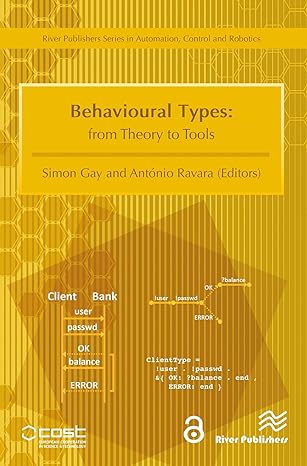
Behavioural type systems in programming languages support the specification and verification of properties of programs beyond the traditional use of type systems to describe data processing.
-
This book presents an informal and friendly introduction to some of the core ideas in modern computer science, using the programming language Perl as its vehicle.
-
This book is a series of notes about programming languages, originally written for students of the undergraduate programming languages course at The University of Texas at Austin. It uses Haskell, a pure functional language.
-
This book unites two approaches to teaching programming languages, one based on a survey of languages and the other on writing definitional interpreters. It has been used as a textbook at over fifteen institutions worldwide, and is referenced by non-academic users on the Web. The book is updated approximately every year. You can learn about the differences between versions, and get the accompanying software, from the book's Web site.
-
This book offers an excellent introduction to a wide range of programming language concepts. They are all uniformly and carefully explained, using techniques that are very useful in practice for both analysis and implementation of programming languages.
-
This book is an introduction to the study of programming languages. The material has evolved from lecture notes used in a programming languages course for juniors, seniors, and graduate students at Johns Hopkins University.