The R Programming Language
Reference documents in The R Programming Language.
Documents in The R Programming Language
Page 1 of 3-
Begin developing your mastery of the powerful R programming language. Become comfortable with the R environment and learn how to find ways for R to fulfill your data needs. With author Barton Poulson as your guide, you will soon be making use of this flexible, unparalleled tool. Unprecedented control of your data is within your grasp!
-
This book provides an elementary-level introduction to R, targeting both non-statistician scientists in various fields and students of statistics.
-
This book is a quick guide to using R, free-access software available for Windows and Mac operating systems that allows users to customize statistical analysis. It provides data analysis examples, R code, computer output, and explanation of results for every multivariate statistical application included.
-
This book presents a much easier way to write books and technical publications than traditional tools such as LaTeX and Microsoft Word. You can make better use of document elements such as figures, tables, equations, theorems, citations, and references. Similar to LaTeX, you can number and cross-reference these elements with bookdown.
-
This book provides a practical guide for creating websites using the blogdown package in R. It shows you how to use dynamic R Markdown documents to build static websites featuring R code (or other programming languages) with automatically rendered output such as graphics, tables, analysis results, and HTML widgets.
-
This is the first official book authored by the core R Markdown developers that provides a comprehensive and accurate reference to the R Markdown ecosystem.
-
The Art of R Programming takes you on a guided tour of software development with R, from basic types and data structures to advanced topics like closures, recursion, and anonymous functions. No statistical knowledge is required, and your programming skills can range from hobbyist to pro.
-
It is impossible to become expert in R in only one training course. Yet, this course aims at giving a wide understanding of many aspects of R. Some external resources will be referred to in this book for you to be able to deepen what you would have learned in this course.
-
A Step-by-Step Tutorial in R has a two-fold aim: to learn the basics of R and to acquire basic skills for programming efficiently in R. Emphasis is on converting ideas about analysing data into useful R programs. It is stressed throughout that programming starts first by getting a clear understanding of the problem. Once the problem is well formulated the next phase is to write step-by-step code for execution by the R evaluator.
-
The objective of this book is to introduce participants to the use of R for data manipulation and analysis. It is intended for individuals with little or no prior experience in R. The topics that are covered are those that author thinks are the most important for getting started with R. By the end of the book, you should be able to complete all steps reguired for data analysis and visualization using R, including the use of some relatively sophisticated methods.
-
An Essential Reference for Intermediate and Advanced R Programmers
-
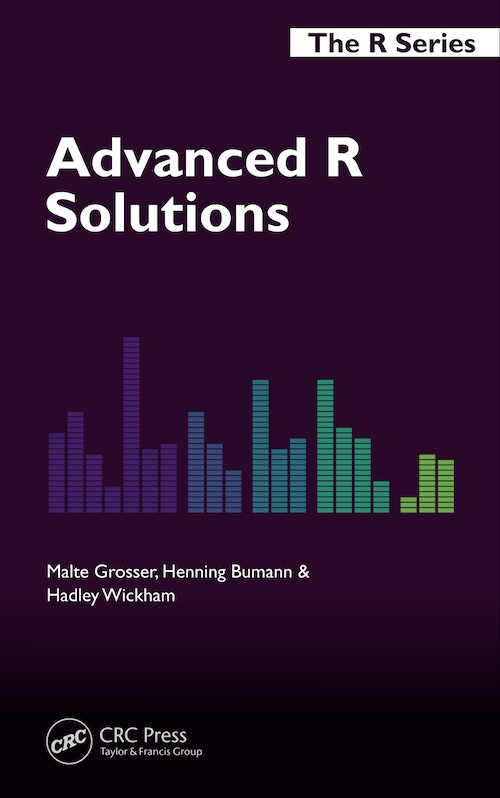
This book offers solutions to the exercises from Hadley Wickham's book Advanced R (Edition 2). It is work in progress and under active development. The 2nd edition of Advanced R is in print now and we hope to provide most of the answers.
-
This book helps you understand how R works at a fundamental level. It is designed for R programmers who want to deepen their understanding of the language, and programmers experienced in other languages who want to understand what makes R different and special.
-
The aim of this book is to introduce you to using R, a powerful and flexible interactive environment for statistical computing and research. R in itself is not difficult to learn, but as with learning any new language (spoken or computer) the initial learning curve can be a little steep and somewhat daunting.
-
Data science has taken the world by storm. Every field of study and area of business has been affected as people increasingly realize the value of the incredible quantities of data being generated. But to extract value from those data, one needs to be trained in the proper data science skills.