Statistics, Mathematical Statistics, and SAS
Reference documents in Statistics, Mathematical Statistics, and SAS.
Documents in Statistics, Mathematical Statistics, and SAS
Page 2 of 2-
This book follows the scope and sequence of a one-semester, introduction to statistics course and is geared toward students majoring in fields other than math or engineering. This text assumes students have been exposed to intermediate algebra, and it focuses on the applications of statistical knowledge rather than the theory behind it.
-
This book takes readers on a journey of statistical discovery using the freeware R. This book is written in an irreverent style and follows the same ground breaking structure and pedagogical approach. The core material is enhanced by a cast of characters to help the reader on their way, hundreds of examples, self assessment tests to consolidate knowledge, and additional website material for those wanting to learn more.
-
This open access book presents the key aspects of statistics in Wasserstein Spaces, i.e. statistics in the space of probability measures when endowed with the geometry of optimal transportation.
-
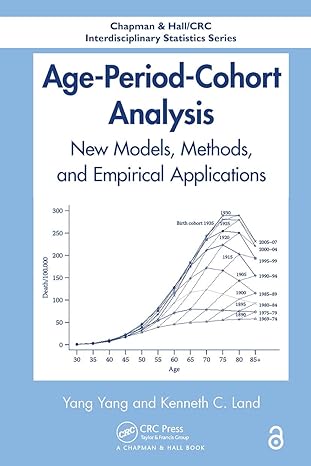
Encompassing both methodological expositions and empirical studies, this book explores the ways in which statistical models, methods, and research designs can be used to open new possibilities for Age-Period-Cohort (APC).
-
This Open access book gives an overview of current research and developments on the incorporation of machine learning in Official Statistics. It covers methodological questions, practical aspects and cross-cutting issues.
-
A practitioner's guide to designing reliable AI/LLM-powered workflows for Official Statistics and research in high-accountability environments. Covers the full lifecycle from design through deployment: classification and coding workflows, data wrangling, extraction, ensemble and multi-model architectures, pipeline infrastructure, evaluation frameworks, state management and validity, security and supply chain, institutional governance, and cost analysis.
-
Foundations in Statistical Reasoning is designed for students taking an introductory statistics class. The emphasis throughout the entire book is on how to make decisions with only partial evidence.
-
This book is directed toward students for whom mathematical statistics is or will become an important part of their lives. Obviously, such students should be able to work through the details of 'hard' proofs and derivations.
-
This book was written as an aid in the beginning statistics course to students whose mathematical background is limited to basic algebra. The book follows a non-theoretical approach without formal proofs, explaining concepts intuitively and supporting them with abundant examples.
-
This book gives you the tools to understand statistical claims and avoid common pitfalls associated with translating statistical information from the language of mathematics to plain English.
-
Covers the analysis of contingency tables, t-tests, correlation, regression, ANOVA and factor analysis, while also giving students a firm grounding in descriptive statistics and graphing. It includes learning aids for applying statistical principles using the Jamovi interface, as well as embedded data files to accompany the book, and comprehensive chapters on probability theory, sampling and estimation, and null hypothesis testing.
-
This book is a true introduction, not assuming any prior training in statistics. It minimizes use of math (beyond the very elementary) in initial explanations, instead focusing on conceptual description and interpretation.
-
This open access textbook provides the background needed to correctly use, interpret and understand statistics and statistical data in diverse settings. Readers with little or no background in statistics will appreciate how these fundamental concepts are so well illustrated.