Software Containers & Virtualization
Reference documents in Software Containers & Virtualization.
Documents in Software Containers & Virtualization
Page 2 of 2-
Kubernetes has gained significant popularity over the past few years, with OpenShift as one of its most mature and prominent distributions. This practical book helps you understand and manage OpenShift clusters from minimal deployment to large multicluster installations.
-
The next generation of software containers is here. Learn Podman directly from its creator, discover its exceptional security features, and start managing rootless containers that integrate easily into your systems.
-
Learn where the DevOps industry stands today and discover where it’s heading. You’ll dive into core topics such as continuous delivery adoption, benefits, and barriers; automation in the software development life cycle; software delivery practices, techniques, and metrics; and more.
-
Podman Desktop provides a graphical interface for application developers to work seamlessly with containers and Kubernetes in a local environment. The application offers an easy-to-use dashboard to interact with and manage containers, images, pods and more. Podman Desktop also bridges with the Kubernetes environment, enabling you to deploy your applications, inspect them and optimize your developer turnarounds.
-
This guide provides common reusable elements, patterns, principles, and practices for designing and implementing cloud-native applications on Kubernetes.
-
Kubernetes is an open source orchestration platform to manage containers in a cluster environment. With Kubernetes, you can configure and deploy containerized applications easily.
-
This book is designed to introduce you to using containers and Kubernetes for full-stack development. You'll learn how to develop a full-stack application using Ruby on Rails and PostgreSQL with Sidekiq, and how to manage them all - first with Docker, then with Docker Compose, and finally with Kubernetes.
-
The traditional way to deploy Java applications requires installing the Java Development Kit (JDK), plus an application server, web server, database, and other components in a data center or in the cloud. Though this process works well enough, Docker containers can save you many headaches when it comes to packaging, deploying, and scaling your applications.
-
This book introduces key Kubernetes concepts such as pods—collections of containers—and shows you how these entities interact with your Java application. Kubernetes is the leading container orchestration tool.
-
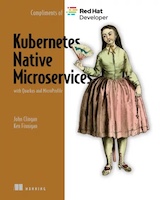
Build fast, efficient Kubernetes-based Java applications using the Quarkus framework, MicroProfile, and Java standards.