Numerical Analysis and Scientific Computing
Reference documents in Numerical Analysis and Scientific Computing.
Documents in Numerical Analysis and Scientific Computing
Page 1 of 1-
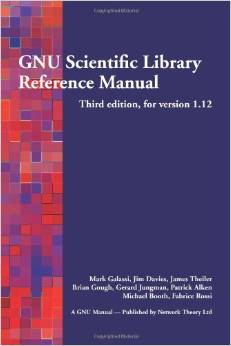
The GNU Scientific Library (GSL) is a free numerical library for C and C++ programmers. It provides over 1,000 routines for solving mathematical problems in science and engineering. Written by the developers of GSL this reference manual is the definitive guide to the library.
-
This is a textbook that teaches the bridging topics between numerical analysis, parallel computing, code performance, large scale applications.
-
A brief introduction to scientific computing with GNU Octave. Designed as a textbook supplement for freshman and sophomore level linear algebra and calculus students.
-
This book is intended for researchers in applied mathematics and scientific computing as well as for practitioners interested in understanding the theory of numerical methods used for eigenvalue problems. It also can be used as a supplemental text for an advanced graduate-level course on these methods.
-
This book teaches the principals of Fourier spectral methods, their utility in solving partial differential equation and how to implement them in code. Performance considerations for several Fourier spectral implementations are discussed and methods for effective scaling on parallel computers are explained.
-
This book entitled Numerical Methods with Applications is written primarily for engineering undergraduates taking a course in Numerical Methods. The textbook offers a unique treatise to numerical methods which is based on a holistic approach and short chapters.
-
Exploring the techniques of interpolating data allows us to view the development and birth of a polynomial. This text is focused on laying a foundation for understanding and applying several common forms of Polynomial Interpolation.
-
This textbook was born of a desire to contribute a viable, free, introductory Numerical Analysis textbook for instructors and students of mathematics. The ultimate goal of this book is to be a complete, one-semester, single-pdf, downloadable textbook designed for mathematics classes.
-
This is a book about numerically solving partial differential equations occurring in technical and physical contexts and the authors have set themselves a more ambitious target than to just talk about the numerics.
-
The main topic of the book entails the description of classical numerical methods that are used to approximate the solution of partial differential equations. The focus is on discretization methods such as the finite difference, finite volume and finite element method.
-
In this book we discuss several numerical methods for solving ordinary differential equations. We emphasize the aspects that play an important role in practical problems. The numerical examples in this book were implemented in Matlab, but also Python or any other programming language could be used.
-
This unique open access book applies the functional OCaml programming language to numerical or computational weighted data science, engineering, and scientific applications. This book is based on the authors' first-hand experience building and maintaining Owl, an OCaml-based numerical computing library.
-
This is the revised and expanded second edition of the hugely popular Numerical Recipes: the Art of Scientific Computing. The product of a unique collaboration among four leading scientists in academic research and industry, Numerical Recipes is a complete text and reference book on scientific computing.
-
The newest product in the hugely popular Numerical Recipes series, Numerical Recipes in Fortran 90 has three completely new chapters that start with a detailed introduction to the Fortran 90 language and then present the basic concepts of parallel programming with the same clarity and cheer for which Numerical Recipes is famous.
-
The book is based on “First Semester in Numerical Analysis with Julia”, written by Giray Ökten. The contents of the original book are retained, while all the algorithms are implemented in Python (Version 3.8.0).