Number Theory
Reference documents in Number Theory.
Documents in Number Theory
Page 1 of 1-
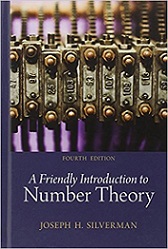
This book is an introductory text designed to entice non-math majors into learning some mathematics, while at the same time teaching them how to think mathematically. The exposition is informal, with a wealth of numerical examples that are analyzed for patterns and used to make conjectures. Only then are theorems proved, with the emphasis on methods of proof rather than on specific results.
-
This volume contains the two most important essays on the logical foundations of the number system by the famous German mathematician J. W. R. Dedekind.
-
This graduate-level text provides coverage for a one-semester course in Algebraic Number Theory. It explores the general theory of factorization of ideals in Dedekind domains as well as the number field case. Detailed calculations illustrate the use of Kummer's theorem on lifting of prime ideals in extension fields.
-
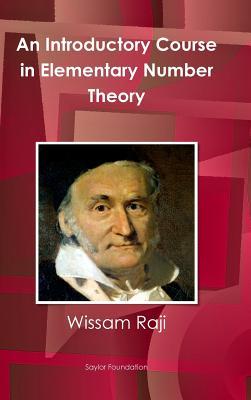
These notes serve as course notes for an undergraduate course in number theory. Most if not all universities worldwide offer introductory courses in number theory for math majors and in many cases as an elective course.
-
Number theory and its applications are well known for their proven properties and excellent applicability in interdisciplinary fields of science. Until now, research on number theory and its applications has been done in mathematics, applied mathematics, and the sciences.
-
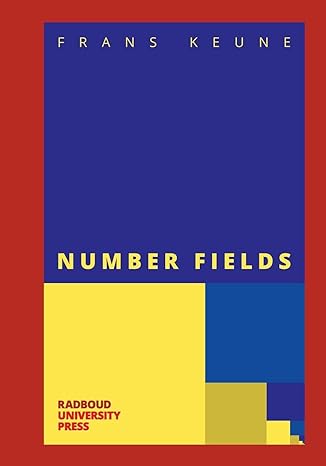
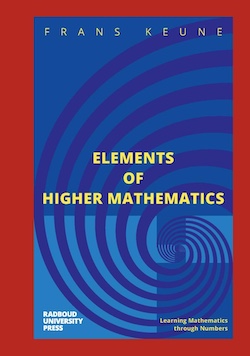
This is a textbook for Algebraic Number Theory, focuses on the abstract theory and contains many examples and exercises. It grew out of lecture notes of master courses taught by the author at Radboud University, the Netherlands, over a period of more than four decades. It is self-contained in the sense that it uses only mathematics of a bachelor level, including some Galois theory.
-
Unlock the mysteries of integers and their properties with this book - your comprehensive guide to the fascinating world of number theory. It offers a meticulous exploration of the core concepts and advanced topics within number theory.
-
Articles in this volume are based on talks given at the Gauss-Dirichlet Conference held in Gottingen on June 20-24, 2005. The conference commemorated the 150th anniversary of the death of C.-F. Gauss and the 200th anniversary of the birth of J.-L. Dirichlet.
-
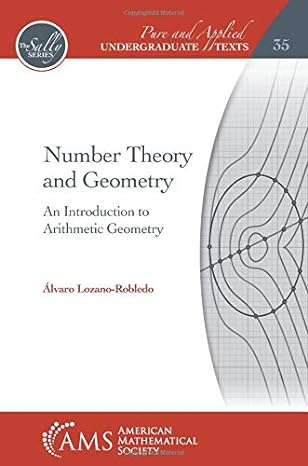
Geometry and the theory of numbers are as old as some of the oldest historical records of humanity. This book is an introduction to number theory and Arithmetic Geometry, and the goal of the text is to use geometry as the motivation to prove the main theorems in the book.
-
This book serves as an introduction to number theory at the undergraduate level, emphasizing geometric aspects of the subject. The geometric approach is exploited to explore in some depth the classical topic of quadratic forms with integer coefficients, a central topic of the book.
-
This book, which presupposes familiarity only with the most elementary concepts of arithmetic (divisibility properties, greatest common divisor, etc.), is an expanded version of a series of lectures for graduate students on elementary number theory.
-
This is a textbook for beginning mathematics students. Knowledge of school mathematics is not presumed: it starts with the basics of counting. The underlying idea is that the best way to learn mathematics is by doing mathematics.
-
This introductory number theory textbook has a particular emphasis on connections to cryptology.
-
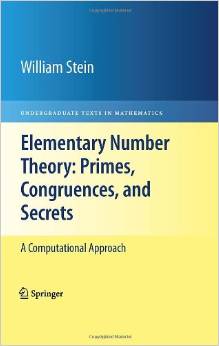
This book is an introduction to elementary number theory with a computational flavor. Many numerical examples are given throughout the book using the SageMath mathematical software. The text is aimed at an undergraduate student with a basic knowledge of groups, rings and fields. Each chapter concludes with several exercises.