Neural Networks and Deep Learning
Reference documents in Neural Networks and Deep Learning.
Documents in Neural Networks and Deep Learning
Page 1 of 2-
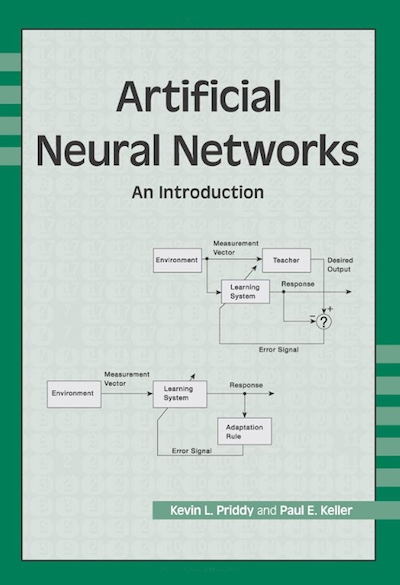
This tutorial text provides the reader with an understanding of Artificial Neural Networks (ANNs) and their application, beginning with the biological systems which inspired them, through the learning methods that have been developed and the data collection processes, to the many ways ANNs are being used today.
-
This book aims to discuss the usage of Artificial Neural Networks (ANNs) for optimal solving of time series applications and clustering. It demonstrates how different fields of studies utilize ANNs proving its wide reach and relevance.
-
Artificial Neural Networks (ANN) may probably be the single most successful technology in the last two decades which has been widely used in a large variety of applications. The purpose of this book is to provide recent advances of architectures, methodologies, and applications of artificial neural networks.
-
The idea of simulating the brain was the goal of many pioneering works in Artificial Intelligence. The brain has been seen as a neural network, or a set of nodes, or neurons, connected by communication lines. Currently, there has been increasing interest in the use of neural network models.
-
Since their re-popularisation in the mid-1980s, artificial neural networks have seen an explosion of research across a diverse spectrum of areas. While an immense amount of research has been undertaken in artificial neural networks themselves--in terms of training, topologies, types, etc. - a similar amount of work has examined their application to a whole host of real-world problems. Such problems are usually difficult to define and hard to solve using conventional techniques. Examples include computer vision, speech recognition, financial applications, medicine, meteorology, robotics, hydrology, etc.
-
In this book, highly qualified multidisciplinary scientists grasp their recent researches motivated by the importance of Artificial Neural Networks (ANN).
-
Generative Adversarial Networks (GANs) are an incredible AI technology capable of creating images, sound, and videos that are indistinguishable from the "real thing." By pitting two neural networks against each other -- one to generate fakes and one to spot them -- GANs rapidly learn to produce photo-realistic faces and other media objects. With the potential to produce stunningly realistic animations or shocking deepfakes, GANs are a huge step forward in deep learning systems.
-
This fundamental book on Artificial Neural Networks (ANN) has its emphasis on clear concepts, ease of understanding and simple examples. Written for undergraduate students, the book presents a large variety of standard neural networks with architecture, algorithms and applications.
-
This book describes recent theoretical advances in the study of artificial neural networks. It explores probabilistic models of supervised learning problems, and addresses the key statistical and computational questions.
-
This book, by the authors of the Neural Network Toolbox for MATLAB, provides a clear and detailed coverage of fundamental neural network architectures and learning rules.
-
Previously, Artificial Neural Networks have been used to capture only the informal properties of music. However, cognitive scientist Michael Dawson found that by training artificial neural networks to make basic judgments concerning tonal music, such as identifying the tonic of a scale or the quality of a musical chord, the networks revealed formal musical properties that differ dramatically from those typically presented in music theory.
-
Artificial Neural Networks (ANN) may probably be the single most successful technology in the last two decades which has been widely used in a large variety of applications in various areas. The purpose of this book is to provide recent advances of artificial neural networks in biomedical applications.
-
Deep Learning is a new area of Machine Learning research, which has been introduced with the objective of moving Machine Learning closer to one of its original goals: Artificial Intelligence.
-
This modern and self-contained book offers a clear and accessible introduction to the important topic of machine learning with neural networks. In addition to describing the mathematical principles of the topic, and its historical evolution, strong connections are drawn with underlying methods from statistical physics and current applications within science and engineering.
-
This book leads you through the fundamental concepts of neural networks, including its architecture, its input-output, tanh and softmax activation, back-propagation, error and accuracy, normalization and encoding, and model interpretation.