Linear and Matrix Algebra
Reference documents in Linear and Matrix Algebra.
Documents in Linear and Matrix Algebra
Page 1 of 2-
This textbook on the basics of option pricing is accessible to readers with limited mathematical training. It is for both professional traders and undergraduates studying the basics of finance. Assuming no prior knowledge of probability.
-
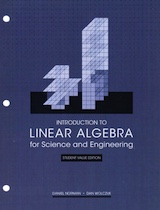
This book helps Science and Engineering students understand and apply theory and concepts by combining theory with computations and slowly bringing students to the difficult abstract concepts.
-
In order not to intimidate students by a too abstract approach, this textbook on linear algebra is written to be easy to digest by non-mathematicians. It introduces the concepts of vector spaces and mappings between them without dwelling on statements such as theorems and proofs too much. It is also designed to be self-contained, so no other material is required for an understanding of the topics covered.
-
Linear algebra is one of the fundamental tools for computational and data scientists. This document, titled "Advanced Linear Algebra: Foundations to Frontiers" (ALAFF) is an alternative to a traditional text for a graduate course on advanced linear algebra for computing.
-
This open access book discusses proof-based linear algebra. Because of the proof-based nature of this book, readers are recommended to be familiar with mathematical proof before reading this book (although this is not a prerequisite, strictly speaking), so that their reading experiences can be smoother.
-
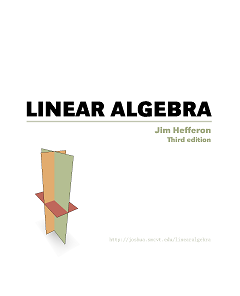
This textbook covers linear systems and Gauss' method, vector spaces, linear maps and matrices, determinants, and eigenvectors and eigenvalues. Each chapter has three or four discussions of additional topics and applications.
-
This book covers theoretical aspects of the subject, along with examples, computations, and proofs. It explores a variety of advanced topics in linear algebra that highlight the rich interconnections of the subject to geometry, algebra, analysis, combinatorics, numerical computation, and many other areas of mathematics.
-
The text aims to support readers as they develop their ability to think about linear algebra conceptually, their computational fluency (with SageMath), and their understanding of the role that linear algebra plays in shaping our society.
-
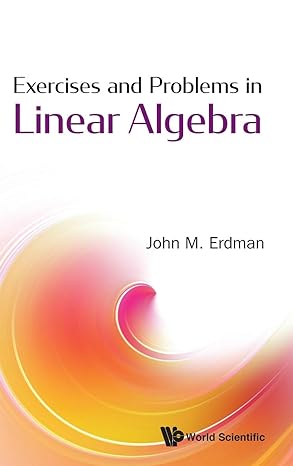
This book contains an extensive collection of exercises and problems that address relevant topics in linear algebra. The exercises will be both interesting and helpful to an average student.
-
The book concisely presents the fundamental aspects of the theory of operators on Hilbert Spaces. The topics covered include functional calculus and spectral theorems, compact operators, trace class and Hilbert-Schmidt operators, self-adjoint extensions of symmetric operators, and one-parameter groups of operators.
-
The book presents an introduction to the fascinating subject of linear algebra. As the title suggests, this text is designed as a first course in linear algebra for students who have a reasonable understanding of basic algebra. Major topics of linear algebra are presented in detail, with proofs of important theorems provided.
-
Presented in a conversational style with plenty of motivation, illustrations, applications, and theory, this textbook should be a comfortable read for most beginning mathematicians. Readers and instructors alike will appreciate the numerous detailed exercise solutions accompanying each section.
-
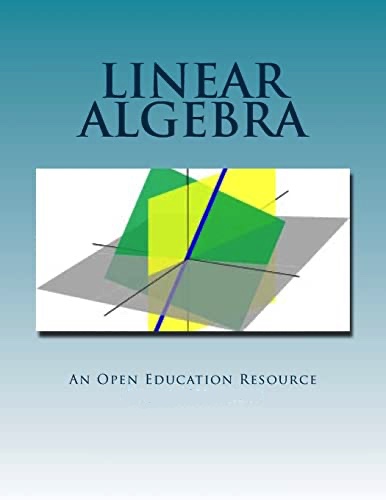
This book begins by developing a conceptual framework for the topic using the central objects, vector spaces and linear transformations. It covers the same concepts, skills, and, applications as conventional Linear Algebra texts in a one-semester course, but students walk away with a much richer and more useful mastery of the topics.
-
This book and its companion site "allthemath" are completely and forever free and open source educational materials dedicated to the mathematics that budding computer science practitioners actually need to know.
-
The text focuses on the central goal of linear algebra: understanding the structure of linear operators on finite-dimensional vector spaces. The author has taken unusual care to motivate concepts and simplify proofs.