Electronic Engineering
Reference documents in Electronic Engineering.
Documents in Electronic Engineering
Page 1 of 2-
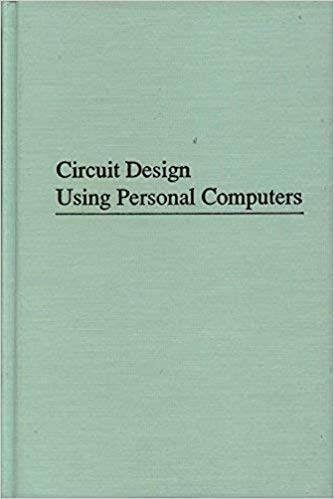
This practical guide to designing electronic circuits using small computers and programmable calculators makes it easy to implement both classical and sophisticated design techniques. It uses the interaction between circuit designer and computer to clarify both design techniques and fundamental concepts. It also shows how to produce useful answers quickly, while developing a feel (or the procedure and obtaining insight into fundamental processes - such as the errors between exact derivatives and their finite-difference estimates.
-
This book covers Direct Current (DC) circuit theory: The basics for circuits that include DC sources (voltage or current) and resistors; Problem solving techniques for circuits that include only DC sources and resistors; Capacitors and inductors.
-
This book covers Alternating Current (AC) circuit theory as well us a brief introduction of electronics. It covers the basic theory of AC signals, sinusoidal waveforms, square waves, triangle waves, the mathematics background, resistors, inductors, and capacitors.
-
This book is intended for engineering students pursuing courses in institutions of higher learning. The aim of this book is to assist students in understanding the basic concepts of circuit theory and developing the fundamental tools of linear circuit analysis, which will be useful for all engineers. Students will learn about the various components of circuits, including wires, resistors, capacitors, inductors, voltage and current sources, and operational amplifiers. This book is also suitable for students intending to pursue more advanced courses in circuit analysis.
-
An essential and practical text for both students and teachers of AC electrical circuit analysis, this text picks up where the companion DC electric circuit analysis text leaves off. Beginning with basic sinusoidal functions, ten chapters cover topics including series, parallel, and series-parallel RLC circuits. Numerous theorems and analysis techniques are examined including superposition, Thévenin's theorem, nodal and mesh analysis, maximum power transfer and more.
-
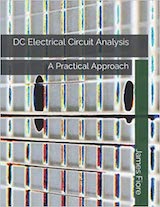
A practical and thorough treatment of DC circuit analysis, this text begins with coverage of scientific and engineering notation along with the metric system. Also included is a discussion of the scientific method – the basis of our modern system of investigation and technology. From there, basic concepts and quantities are introduced such as charge, current, energy, power and voltage. Subsequent chapters introduce resistance, series circuits, parallel circuits and series-parallel circuits.
-
The objective of this textbook is presenting circuit analysis in a clearer, more interesting, and easier to understand manner. A balance of theory, worked & extended examples, practice problems, and real-world applications.
-
A free 6 volumes series of textbooks on the subjects of electricity and electronics.
-
This book has been written for students on electrical engineering courses who don't necessarily possess prior knowledge of electrical circuits. Based on the author's own teaching experience, it covers the analysis of simple electrical circuits consisting of a few essential components using fundamental and well-known methods and techniques. Contains video lectures and associated study guides used to support the flipped classroom approach to teaching basic electricity and electronics.
-
Focused on how certain devices or circuits might be used in practical applications. Examples include power supplies, CMOS inverters in computer processors, signal modulators, and several others.
-
This book explored recent innovations of researchers working for the development of smart and green technologies in the fields of Energy, Electronics, Communications, Computers, and Control. It provides innovators to identify new opportunities for the social and economic benefits of society.
-
This book covers the theory and application of discrete semiconductor devices including various types of diodes, bipolar junction transistors, JFETs, MOSFETs and IGBTs. Applications include rectifying, clipping, clamping, switching, small signal amplifiers and followers, and class A, B and D power amplifiers.
-
A systematic theory of DIY electronic culture, drawn from a century of artists who have independently built creative technologies.
-
This book provides a solid overview of the electrical engineering discipline that is especially geared toward the many non-electrical engineering students. The hallmark feature of the text is its liberal use of practical applications to illustrate important principles.
-
The book adopts an untraditional approach to introducing semiconductor devices to beginners. It uses circuit theory to provide a digestible explanation of energy band theory and understanding of energy band diagrams.