Discrete and Finite Mathematics
Reference documents in Discrete and Finite Mathematics.
Documents in Discrete and Finite Mathematics
Page 1 of 2-
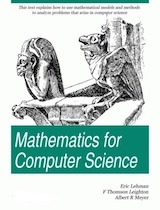
This book introduces the mathematics that supports advanced computer programming and the analysis of algorithms. The primary aim of its well-known authors is to provide a solid and relevant base of mathematical skills - the skills needed to solve complex problems, to evaluate horrendous sums, and to discover subtle patterns in data.
-
Applied Finite Mathematics covers topics including linear equations, matrices, linear programming (geometrical approach and simplex method), the mathematics of finance, sets and counting, probability, Markov chains, and game theory.
-
This book demonstrates how mathematics applies to various fields of study. The text is packed with real data and real-life applications. It uses a large number of applications based on real data from business, economics, and the life and social sciences to help you see how mathematics relates to your own life and interests.
-
The goal of this book is for the students mathematical maturity and appreciation for the usefulness of mathematics to grow simultaneously.
-
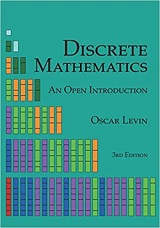
Discrete mathematics is fundamental to computer science, and this up-to-date text assists undergraduates in mastering the ideas and mathematical language to address problems that arise in the field's many applications. It consists of four units of study: counting and listing, functions, decision trees and recursion, and basic concepts of graph theory.
-
This book gives thorough coverage to topics that have great importance to computer scientists and provides a motivating computer science example for each math topic. Contents: Counting; Cryptography and Number Theory; Reflections on Logic and Proof.
-
This book gives an introduction to discrete mathematics for beginning undergraduates. One of original features of this book is that it begins with a presentation of the rules of logic as used in mathematics. Many examples of formal and informal proofs are given.
-
The aim of this book is to present some the basic mathematics that is needed by computer scientists. The reader is not expected to be a mathematician and we hope will find what follows useful.
-
This book provides a broad introduction to some of the most fascinating and beautiful areas of discrete mathematical structures. It starts with a chapter on sets and goes on to provide examples in logic, applications of the principle of inclusion and exclusion and finally the pigeonhole principal.
-
This is a textbook that covers the standard topics in a sophomore-level course in discrete mathematics: logic, sets, proof techniques, basic number theory, functions, relations, and elementary combinatorics, with an emphasis on motivation. It explains and clarifies the unwritten conventions in mathematics, and guides the students through a detailed discussion on how a proof is revised from its draft to a final polished form. Hands-on exercises help students understand a concept soon after learning it.
-
This book contains most of the fundamental concepts taught in a one semester course in discrete mathematics. It corresponds with the content of Discrete Structures I at Umass Lowell, which is a required course for students in Computer Science, Mathematics and Information Technology.
-
This gentle introduction to discrete mathematics is written for first and second year math majors, especially those who intend to teach. The text began as a set of lecture notes for the discrete mathematics course at the University of Northern Colorado.
-
This book covers elementary discrete mathematics for computer science and engineering. It emphasizes mathematical definitions and proofs as well as applicable methods. It explores the topics of basic combinatorics, number and graph theory, logic and proof techniques, and many more.
-
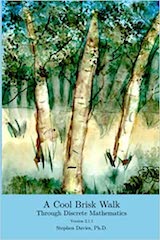
A Cool Brisk Walk Through Discrete Mathematics - and its companion site "allthemath.org" - are completely and forever free and open source educational materials dedicated to the mathematics that budding computer science practitioners actually need to know. They feature the fun and addictive teaching of award-winning lecturer Dr. Stephen Davies of the University of Mary Washington in Fredericksburg, Virginia!
-
This book explains complex, abstract concepts with clarity and precision and provides a strong foundation for computer science and upper-level mathematics courses of the computer age.