Bayesian Thinking
Reference documents in Bayesian Thinking.
Documents in Bayesian Thinking
Page 1 of 1-
This work is primarily a research document on the application of probability theory to the parameter estimation problem. The people who will be interested in this material are physicists, economists, and engineers who have to deal with data on a daily basis; consequently, we have included a great deal of introductory and tutorial material.
-
Master Bayesian Inference through Practical Examples and Computation - Without Advanced Mathematical Analysis
-
This book provides a self-contained introduction to computational Bayesian statistics using R programming language. With its primary focus on Bayes factors supported by data sets, this book features an operational perspective, practical relevance, and applicability―keeping theoretical and philosophical justifications limited.
-
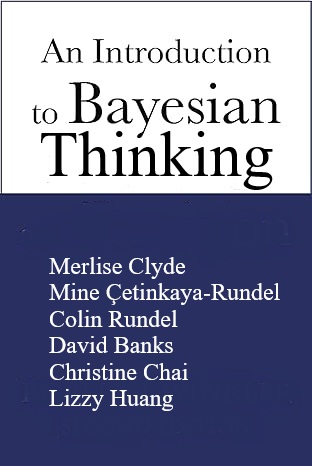
An engaging, sophisticated, and fun introduction to the field of Bayesian statistics, this book brings the power of modern Bayesian thinking, modeling, and computing to a broad audience. In particular, the book is an ideal resource for advanced undergraduate statistics students and practitioners with comparable experience.
-
The goal of this book is to provide an introduction to Bayesian Inference in decision making without requiring calculus. It may be used on its own as an open-access introduction to Bayesian inference using R Programming Language for anyone interested in learning about Bayesian statistics.
-
Master Bayesian Inference through Practical Examples and Computation - Without Advanced Mathematical Analysis.
-
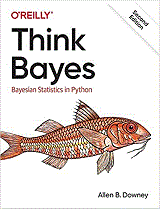
If you know how to program, you're ready to tackle Bayesian statistics. With this book, you'll learn how to solve statistical problems with Python code instead of mathematical formulas, using discrete probability distributions rather than continuous mathematics. Once you get the math out of the way, the Bayesian fundamentals will become clearer and you'll begin to apply these techniques to real-world problems.
-
Machine learning methods extract value from vast data sets quickly and with modest resources. They are established tools in a wide range of industrial applications, including search engines, DNA sequencing, stock market analysis, and robot locomotion, and their use is spreading rapidly. People who know the methods have their choice of rewarding jobs.